skip to main |
skip to sidebar
Lacelle D, Juneau V, Pellerin A, Lauriol B, Clark ID. 2008. Weathering regime and geochemical conditions in a polar desert environment, Haughton impact structure region, Devon Island, Canada. Canadian Journal of Earth Science 45: 1139-1157.
These authors examined the soils and waters near the Haughton crater on Devon Island, to determine the importance of chemical and mechanical weathering in this polar desert environment. They examined dissolved material in streams, lakes, snow, and groundwaters, and the size distribution, shape, and chemical composition of particles from soils in several different local landforms and parent materials.
Despite low temperatures, low precipitation, and very low vegetation presence, significant chemical weathering was found. Signs of chemical weathering, rather than mechanical, include rounded surfaces and pits in sand particles and the concentrations of Ca2+, Mg2+, and HCO3- in waters. Signs of mechanical weathering were also found, including sharp fracture lines in particles.
A gradient of increasing chemical weathering and decreasing mechanical weathering was found from the surface to the permafrost table. Thermal buffering reduces the frequency of frost-driven forces and thermal expansion from daily at the surface to annually at the permafrost table. The permafrost acts as a barrier to water movement, creating relatively wet condtions at depth that allow aqueous chemistry including the dissolution of dolomite to proceed.

Huang Y, Zou J, Zheng X, Wang Y, Xu X. 2004. Nitrous oxide emissions as influenced by amendment of plant residues with different C:N ratios. Soil Biology & Biochemistry 36: 973-981.These authors examined the role of residue quality, in the form of C:N ratio and a range of crop residues, on N2O emissions from soils. They also measured CO2 emissions, and found strong correlations between organic-matter decomposition and respiration, and nitrogen cycling.Gas fluxes of CO2 and N2O were highly correlated across all incubations. To ensure only respiration-derived CO2 was measured, the CO2 released by urea breakdown in urea-treated treatments was calculated and subtracted; respiration in the urea-only treatment was similar to that in the untreated controls. Both gas emissions were negatively correlated with residue C:N ratios. Finally, residue C:N ratios were negatively correlated with dissolved organic carbon concentrations. Overall, higher C:N ratios in residues seem to result in slow decomposition of mainly recalcitrant organic matter, and low CO2 and N2O emissions. Addition of urea in conjunction with crop residues produces a range of N2O emissions depending on the C:N ratio of the residues.This short paper may serve as a model for the work I will be doing in the special topics class in soil science, fall 2010.
Trinsoutrot I, Recous S, Mary B, Nicolardot B. 2000. C and N fluxes of decomposing 13C and 15N Brassica napus L.: effects of residue composition and N content. Soil Biology and Biochemistry 32: 1717-1730.These authors studied the decomposition process by soil microorganisms when isotope-labelled crop residues were added to soil. The crop used, oilseed rape Brassica napus (also known as canola) varies its nitrogen content of tissues, and the C:N ratio, depending on levels of N inputs by fertilization. This allows variation in input organic matter quality by manipulation of growing conditions; in this experiment, both carbon and nitrogen inputs to the plant included stable-isotope labels, in the form of 13C-CO2 and 15N-KNO3. Plant residues were added to soils and incubated for 168 days.Initial C:N ratio and especially the labile-C fraction of organic-matter inputs are major controls of both the rate of decomposition and fate of matter through the system. Additionally, temperature, particle size of residues, and water content in the soil also strongly influence decomposition processes. Here, N mineralization (the formation of NO3- and NH4+ pools in the soil from organic-N precursors) occurred in two phases. In the early phase, up to about 3 weeks, the N cycle resulted in net mineralization. Later, mineral N pools were depleted and N was immobilized, that is, incorporated into the tissues of microbial cells.Carbon dioxide release during the experiment occurred through two pathways. The more direct route was rapid mineralization of organic matter, which I interpret as non-incorporation of organic matter by microbes, consuming such material but metabolizing it rapidly through respiration. The second, presumably slower route was through metabolization of material after incorporation into cells through respiration. Either way, the ultimate fate of much of the organic-C in the residues was release as CO2.Differences in the N-content of residues affected decomposition rates early in the experiment, but by about 4 months the differences between high-N and low-N residues had evened out. Only a small fraction of labelled N from residues ended up in soil mineral-N pools; the majority was either immobilized into microbial cells or remained in recalcitrant organic matter fractions. Immobilization of unlabeled, SOM-derived N was enhanced by the addition of C through a substitution effect.These authors conclude that 15N labelling was fraught with difficulties, and both under- and overestimated some pools and processes. However, the use of their model, named NCSOIL, improved their ability to trace the fate of added material through the system. This paper represents a study similar in some ways to our planned course activity in the special topics in soil science course, fall 2010.
Smith KA, Ball T, Conen F, Dobbie KE, Massheder J, Rey A. 2003. Exchange of greenhouse gases between soil and atmosphere: interactions of soil physical factors and biological processes. European Journal of Soil Science 54:779-791.These authors present a broad review paper of the role of soil physical factors, mainly temperature and water-filled-pore-space, in controlling soil emissions of the greenhouse gases CO2, CH4, and N2O. The paper’s goal is stated to be to expose a variety of researchers to the links between soil physics and soil biology, as well as the importance of these fields to current research in many disciplines on global warming.All three gases are produced and consumed in soil primarily by microorganisms, which respond to variation in soil physical parameters in different ways. In general, both temperature and WFPS impact GHG production. Higher temperatures almost always result in increased production of gases, though the Q10 values (measuring the magnitude of response to a change of 10º of temperature) vary widely in the literature for all three gases. The effect of WFPS is different, involving upper and lower bounds, though in the middle range increasing WFPS generally promotes increased gas production. Microbes are limited in their tolerance of dry conditions, such that gas production falls rapidly below some critical WFPS value; for CO2 this threshold is near 20%. WFPS is also indirectly important, through its effects on soil diffusivity. Higher WFPS as well as higher bulk density are associated with lessened CH4 oxidation, due to reduced diffusivity of both CH4 and atmospheric O2. Very high WFPS values are associated with reduction of N2O to N2, partly by limiting O2 supplies and creating larger anaerobic microsites, and partly by preventing the escape of N2O gas into rapid-diffusion pathways; it is trapped in the vicinity of microbes capable of using it as an electron acceptor.There are other factors controlling net GHG emissions, such as the relationship between plant productivity and water table position, which will change the relationship between rates of soil organic matter oxidation to CO2 and the removal of CO2 from the atmosphere by plants; trees in particular can lower local water tables, increasing SOM oxidation while simultaneously consuming more CO2 than the previous wetland vegetation community. I read this paper on the suggestion of my coworkers in the special topics class of fall 2010, but it applies well to the general area of my research. The reference list includes multiple interesting papers addressing particular specialties within this large topic.
Pennock DJ, Zebarth BJ, De Jong E. 1987. Landform classification and soil distribution in hummocky terrain, Saskatchewan, Canada. Geoderma 40: 297-315.These authors present a method of analysing irregular terrain for the purposes of examining important soil parameters such as soil depth and soil hydrology. Three variables (profile curvature, plan curvature, and gradient) can be calculated from a matrix of elevation data; taken together for a given point or area, these variables can be used to classify an area into one of seven landforms. These landforms are level (for summits or bottom lands), shoulders, backslopes, and footslopes; the three non-level forms come in “divergent” (convex plan) and “convergent” (concave plan) varieties. Shoulders have convex profiles, backslopes have flat profiles (i.e. constant gradient when looking up or down the slope), and footslopes are concave. Divergent landforms shed water laterally; convergent landforms tend to collect water. Where water collects and is moving slowly, rates of infiltration will be highest, and erosion will tend to deposit, rather than remove, material at these places.The variables required to calculate profile and plan curvature and gradient are relatively easy to calculate from a matrix of elevation data, using an interpolating topographical software package and some differential calculus. The seven categories of slope elements can be estimated in the field by eye, making for a useful method for field studies.This paper was on the recommended reading list for SLSC 834; in addition, the course instructor is Dr. Pennock, lead author of this study. The study site, near Hafford, Saskatchewan, is perhaps 1 to 1.5 hours drive away from Saskatoon, suggesting this area may be the destination of one of the day trips scheduled for the week of August 30, 2010.
Hayashi M, van der Kamp G, Rudolph DL. 1998. Water and solute transfer between a prairie wetland and adjacent uplands, 1. Water balance. Journal of Hydrology 207: 42-55.These authors report water balance data and analysis in the first of a pair of papers about the hydrology of wetlands in the prairie pothole region of central Saskatchewan. The second paper concerns dissolved material movements in the same example study system.Through a series of measurements of water and water-related properties of soil as well as precipitation, total water balance and total water movements within the wetland were estimated. Direct precipitation and evaporation accounts for a small fraction of the total volume of water entering and leaving the pond in the middle of the hectare-scale wetland and surrounding catchment of uplands. Most of the water entering the pond is in the form of snowmelt during spring, and most of the water leaving the pond is in the form of horizontal groundwater flow, relatively shallowly (i.e. above a redox discontinuity at about 5-6m depth), driven strongly by evapotranspiration through the “willow ring” surrounding the pond and through crops (principally wheat during this experiment) on the uplands. Only a small amount of water is exported down to the aquifer; of a total input of 780mm into the pond, only about 3mm goes to recharging the underlying aquifer. Figure 3 provides definitions of the terminology, and Figure 12 the estimates of water balance.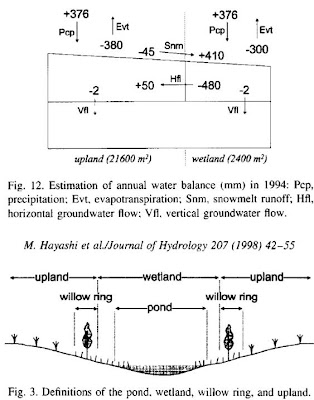 This paper was on the suggested reading list for SLSC 834 in August 2010.
Christiansen EA. 1979. The Wisconsinan deglaciation of southern Saskatchewan and adjacent areas. Canadian Journal of Earth Science 16: 913-938. This author describes in considerable detail the process of deglaciation that occurred at the end of the last glacial maximum from about 17 000 years ago, as it occurs to Saskatchewan. Major geological features and patterns of melt-water drainage led to the inclusion of nearby parts of Alberta, Manitoba, Montana, and North Dakota in the analysis. Patterns during the deglaciation were identified by glacial landforms, many of which are apparent only from aerial photographs, with sample analysis in the lab including radio-carbon dating.The period from 17 000 years to 10 000 years ago is divided into 9 phases corresponding to periods of rapid glacial retreat or temporary stasis or glacial advance. By 10 000 years ago the ice sheet that had covered nearly the entire province had retreated towards Hudson Bay and covered only a small part of the north of Saskatchewan. Glacial lakes formed from meltwater and from water flowing from the west (presumably sourced from glaciers in the Rocky mountains), sometimes reaching enormous sizes; these lakes were bordered by the glacier’s edge, and connected to each other via spillways that often carved large channels from the plains; the east-west valleys of southern Saskatchewan such as the Qu’Appelle valley are the remains of such spillways. Modern river systems such as the Saskatchewan River and the Churchill River formed during the glacial retreat, occupying low areas and spillway remnants.The rate of deglaciation varied considerably over the studied 7 000 years, generally accelerating from about 150 m / yr to around 275 m / yr, though with frequent pauses, occasional re-advances, and variation across the glacial edge. The evidence from glacial lake-edge movements and depth patterns suggests the ice sheet melted fastest initially, but with the slowest retreat at that time indicating the sheet first thinned, and then retreated, especially around newly-uncovered Nunataks where the underlying land formed highlands.This paper was on the suggested reading list for the course SLSC 834 in August 2010, but it is also personally interesting in describing Pleistocene events in areas I visit during Sunday drives across the center of the province.
Wilkinson MT, Richards PJ, Humphreys GS. 2009. Breaking ground: Pedological, geological, and ecological implications of soil bioturbation. Earth-Science Reviews 97: 257-272.These authors describe the process of bioturbation in soils, and the roles of various major groups of organisms, especially animals, responsible for bioturbation. Through mixing and surface-mounding, bioturbation sorts, buries, and transports soil and soil components such as organic matter. Bioturbation also interacts with abiotic processes, particularly those involving surface water inputs and movements, to create net effects on soil movement and sorting.There is a great deal of detail in the description of various sub-processes and rates, as well as some urging for more detailed studies of these phenomena. This paper is required reading for the course SLSC 834, in August 2010.
Johnson DL, Domier JEJ, Johnson DN. 2005. Reflections on the nature of soil and its biomantle. Annals of the Association of American Geographers 95: 11-31.These authors advocate a new paradigm to underlie studies of soil science and related fields, based on increased recognition of processes occurring in and responsible for the production of the “biomantle”, the upper layer of soil composed of and formed by the actions of organisms. Many of these processes are based on movements of soil and soil components, and so are dominated by animals, especially active burrowers that are responsible for large vertical movements of soil in some environments. The biomantle is defined as being composed of “biofabric”, or materials that owe their existence to the actions of organisms, from the bodies of these organisms themselves, to the materials released by the organisms, to the minerals created by biological processes, to the voids created by their movements and the gases filling those voids released by their metabolisms.These authors trace their ideas from the writings of Darwin, particularly his final work involving the activity of worms in “vegetable mould”, a late-18th century term for what we now call soil. A biomantle layer, residing chiefly in the A horizon (or topsoil) can be more easily recognized in some landscapes than others. Humid tropical soils especially may show very thick and distinct biomantles, in two layers. The upper, thicker layer is composed of relatively fine materials, resting on a basal layer of coarser material; this basal layer is referred to here as the stonelayer. Below the stonelayer is non-biomantle, typically a B horizon (or subsoil). The hypothesized process creating this two-layer biomantle is the action of “conveyor belt” animals, especially termites that carry small particles upwards but are unable to move larger stones, thus eventually sorting the soil mineral material. In other soils, such as loess-derived sandy soils without a large component of gravel and larger stones, such a two-layer biomantle may not form, or may be very weakly developed and difficult to identify as such. Nonetheless, bioturbation activity by burrowing animals is usually apparent, for example in the form of “krotovina”, in-filled animal burrows.Besides advocating for a view of soils and their processes with an animal-based, biomantle point of view, these authors spend some time dismissing subaqueous soils (e.g. marine sediments) as simplistic, uncomplicated places lacking many of the key (and very complex) processes that occur in subaerial soils. Their list of such processes near the end of the paper, taken as a kind of justification for their uncited and unsupported dismissal of subaqueous soils, is composed entirely of those processes relating to changing water amounts in terrestrial soils, such as groundwater flow and wetting and drying events. I found their argument unconvincing, as they do not describe any aqueous-only processes such as changes in dissolved-O2 concentrations or the sorting action of water currents, and their blithe disregard for marine biodiversity in statements about how much more diverse the life in terrestrial soils must be, is the proverbial icing on the insult cake. Johnson et al.: please cite some evidence to support such sweeping generalizations.
Stark JM, Hart SC. 1996. Diffusion technique for preparing salt solutions, Kjeldahl digests, and persulfate digests for nitrogen-15 analysis. Soil Science Society of America Journal 60: 1846-1855.These authors evaluated the recently-developed Teflon-encased-acid-trap technique for collecting nitrogen from water samples for analysis, especially stable isotope (15N) analysis. Earlier acid trap techniques, which rely on the chemistry of ammonium/ammonia in solutions of varying pH, were based on suspended small vials containing acid solutions above a larger volume of sample solution at high pH. Ammonium present in the sample is converted to ammonia by high pH, and escapes solution into the gas phase. It is captured in acid solution; in a closed container with a separate acidic region, ammonium will migrate from the alkaline sample to the acid trap. Suspended trap designs are vulnerable to a number of problems, including vulnerability of the acid trap to contamination by alkaline solution and subsequent loss of captured ammonium. Teflon will pass gases but not liquids, and therefore provides an ideal barrier between the sample and the acid trap that will permit ammonia to enter the trap.These authors conducted a set of six experiments to evaluate the utility of Teflon acid traps. First, blanks were evaluated, to determine the sensitivity of the technique to nitrogen derived from contamination in the various materials of the experiment (filter paper, Teflon, plastic bottles, etc.). There was some nitrogen detectable from these non-sample sources, but a correction factor could be constructed based on including a few blanks in sample sets. The second experiment examined the recovery of ammonium from 2M KCl solutions. These solutions are very similar to the solutions extracted from soils of Alexandra Fjord in 2009. As might be expected, incubation time correlated with recovery of ammonium; in addition, Teflon traps performed better over shorter incubations (up to about 6 days) than did suspended traps, though the difference disappeared at the longest (8 days) incubations. The third experiment was of greatest interest to me. They examined the open-bottle time necessary to eliminate residual ammonium from samples used in experiment 2, and the incubation conditions to collect NO3- -derived nitrogen using Devarda’s alloy to reduce NO3- to NH4+. Residual ammonium left in solution at the end of the first reaction would contaminate NO3- examination and lead to overestimation of NO3- contents; this is especially true when the two forms of nitrogen have been previously enriched with 15N to different degrees. There is a trade-off between open bottle time (ranging in these experiments from one to five days) and recovery of NO3- from samples; long open-bottle times appear to lead to an unknown chemical change in samples, which these authors speculate, may involve sorption of atmospheric CO2. Long ammonium-collection times (i.e. experiment 2) do tend to collect the great majority of ammonium present, recovering on average more than 97% of ammonium from known-concentration samples. This suggests to me a long and potentially nitrate-losing open-bottle incubation is not necessary if ammonium collection has proceeded for at least six days. Agitation of samples, in these experiments often once per day, resulted in a strong improvement in nitrogen capture over at least the shorter (24-96 hour) incubations; our use of continuous agitation for seven days therefore seems likely to capture nearly all ammonium present in samples.Experiments 4 through 6 were of little interest to me, as I am unfamiliar with Kjeldahl digests and persulfate digests and do not plan to use these techniques in my studies. From what I could glean based on my limited knowledge, the Teflon-acid-trap technique appears to work well with Kjeldahl digests and persulfate digests.Overall, the Teflon-acid-trap technique performed very well, and had significant ease-of-use and contamination-avoiding advantages over earlier methods. One caution put forth by these authors is regarding the H2 gas evolved during Devarda’s alloy incubations; strong build up of gas can cause leaks, potentially allowing NH3 to escape and leading to underestimates of sample nitrate contents. They suggest storing bottles upside-down during such incubations, as leaks will then include sample solution, and leaking bottles can be easily identified. Complete recovery of nitrogen was not possible on a routine basis using this technique, but 15N isotope ratios do not rely on 100% recovery if ammonium and / or nitrate concentrations have been measured by an independent method, such as the widely-used colorimetric techniques. The two isotopes of nitrogen do not migrate differently between alkaline sample and acid trap, thus even at relatively inefficient recovery rates, isotopic ratios are maintained. Blanks are important, but in general this technique is robust, reliable, and easy to conduct.
Schmidt SK, Reed SC, Nemergut DR, Grandy AS, Cleveland CC, Weintraub MN, Hill AW, Costellow EK, Meyer AF, Neff JC, Martin AM. 2008. The earliest stages of ecosystem succession in high-elevation (5000 metres above sea level), recently deglaciated soils. Proceedings of the Royal Society of London, Series B 275: 2793-2802.These authors describe the microbial community and soil parameters of a chronosequence at the foreground of a receding glacier high in the Peruvian Andes. From a combination of aerial photography and previous work at this site, a series of sites of soils of increasing ages from zero to 79 years old was established. No surface plants, even lichens, are present on any of these new soils, and soil nutrient levels (carbon, nitrogen) are very low; the only organisms present are microorganisms.Two previous hypotheses had been proposed to explain the dynamics of very early primary succession on new soil. Organic matter has been observed to accumulate slowly in new soils; the source of this material is either aeolian deposits (i.e. wind-borne plant detritus and pollen) or in-situ fixation of CO2 and N2. These are not mutually exclusive hypotheses, but the relative contributions of each are explored in this study.The methods used here cover an extensive list of soil parameters. Three sets of soil samples were collected: for microbiological analysis, N-fixation measurement, and all other chemical analyses. The other chemical analyses include photosynthetic pigment extraction, soil total and mineral nitrogen, pyrolysis for identifying sources of carbon compounds (i.e. microbial-autotroph, microbial-heterotroph, plant), enzyme assays for common and informative microbial enzymes, and soil stability analysis of the resistance of these new soils to erosion forces such as water runoff.These authors focused on the cyanobacterial fraction of the microbial community in this study; some details of other components of the biota are described in an earlier paper, Nemergut et al. (2007). Cyanobacteria are autotrophs also capable of fixing atmospheric nitrogen, thus they are ideal primary colonizers of new soil as they require little more than a source of moisture and air. Analysis of the community included the use of the P-test (Martin 2002); note that as in Nemergut et al. (2007), he is one of the authors of this study. The analytical approach is very similar to that employed in the earlier study, with a comparison of discovered sequences to published sequences from around the world. In this study, cyanobacterial sequences from zero and 4-year-old soils were similar to sequences from an extremely broad sample of habitats, including Antarctic lake ice, marine subseafloor sediments, urban aerosols, forest soils, and oil-polluted soils. The soil chronosequence showed a clear pattern of stages of primary succession at every level of analysis. The soil microbial community became both more abundant and more diverse through time, soil nutrients increased, the chemical environment included increasing amounts and diversity of complex organic molecules, key enzyme pathways became established, and soil stability increased as soils aged. N-fixation showed a peak, with increasing N-fixation activity from the zero to 4-year-old soils (by two orders of magnitude), then declining by about half in the 79-year-old soils. This mirrors and precedes a widely-observed pattern in plant primary succession, in which nitrogen-fixing plants are among the first colonizers, but decline in abundance at later stages of succession. Enzyme and organic molecule patterns were consistent with a total absence of heterotrophs in the extremely young soils, increasing occurrence of organisms capable of decomposing plant matter in the 4-year-old soils, and a molecular ecology qualitatively similar to a mature plant-associated soil in the 79-year-old soil. The list of procedures and level of detail of analysis in this paper is impressive. Many, though certainly not all, of these techniques will be models for my own work, especially in the summer of 2010. The molecular-diversity techniques pioneered by Martin (Martin 2002, Nemergut et al. 2007, this paper) as well as the techniques of analyzing soil pigments and soil nutrients are all very interesting.
Philippot L, Piutti S, Martin-Laurent F, Hallet S, Germon JC. 2002. Molecular analysis of the nitrate-reducing community from unplanted and maize-planted soils. Applied and Environmental Microbiology 68: 6121-6128.These authors applied molecular techniques including PCR, RFLP, and sequencing to the study of soil bacteria relevant to crops. Dissimilatory nitrate reduction, the process that converts NO3- to NO2-, is widespread in prokaryotes, with the activity described in alpha, beta, and gamma Proteobacteria, gram-positive bacteria, and some archaea. There are two described enzymes that catalyze the reaction and provide energy to the organism; these authors focused on the membrane-bound protein, specifically one subunit that includes a distinctive set of components. Their approach was to design primers for a well-conserved region of the gene narG that amplify a 650bp region, and then subject the PCR product to cloning, RFLP analysis, and sequencing. Community structure and diversity was compared between pots planted with maize versus unplanted controls. Maize (Zea mays) is a plant that facilitates gas diffusion in its roots under oxygen-stress soil conditions; this creates an aerobic region in the rhizosphere distinct from anaerobic conditions further from roots. While diversity, as measured by standard indices, did not differ between planted and unplanted soils, the structure of the communities did change, with numerous RFLP phylotypes found in only one or the other treatment. This suggests a role of rhizosphere conditions, likely involving both oxygen and root exudates, in selecting for particular groups of microorganisms.Nitrate reduction occurs primarily or possibly only under aerobic conditions. The microbial cell gains energy from dissimilatory reduction of nitrate, and if it occurs in the rhizosphere, the plant may gain a readily-accessible form of nitrogen in the form of nitrite. Denitrification, the process that shuttles nitrogen atoms from nitrite to gaseous forms such as N2O or N2, can occur under a range of oxygen conditions, including aerobic, thus denitrifiers in the rhizosphere may compete with plant roots for nitrite. The fate of nitrite produced by dissimilatory nitrate reduction can also be to ammonium, though this appears to be rare in soil and more common in vertebrate guts and digested sludge, two environments typically lacking in oxygen.This paper provides some molecular tools for my own studies of nitrogen dynamics in soils, especially the sequences of the degenerate primers. In addition, it provides some clarification of parts of the remarkably complex soil-nitrogen cycle.
Dandie CE, Miller MN, Burton DL, Zebarth BJ, Trevors JT, Goyer C. 2007. Nitric oxide reductase-targeted real-time PCR quantification of denitrifier populations in soil. Applied and Environmental Microbiology 73: 4250-4258.These authors examined the responses of two major components of the denitrifying bacteria fraction of soil bacteria to the addition of labile carbon (glucose) under denitrifying conditions. Denitrification is presented as a four-step process, with enzymes responsible for shuttling nitrate to N2 via nitrite, nitric oxide, and nitrous oxide. In this study, one of the enzymes responsible for the reduction of NO to N2O, cNOR, was examined using primers optimized for two different groups of denitrifying bacteria. This gene is found only in denitrifiers, unlike another enzyme, qNOR, found in many microorganisms and associated with detoxification, rather than utilization, of dangerous nitric oxide.Primers for qPCR are presented in a table. Specific primers for the two variants of cNOR were developed in this study for use with SYBR green-based qPCR. 16s rRNA sequences were also studied, to examine the total population of soil bacteria; for these qPCR reactions, the TaqMan primers-plus-probe system was used, based on oligonucleotides published by Suzuki et al. 2000. Two experiments were carried out. In the first, a preliminary experiment to establish the utility of qPCR in this area was based on inoculating soils with cultures of bacteria of known cell density, followed by qPCR evaluation of those soils. Under most conditions qPCR performed well, though at low cell densities of some genera of bacteria the signal was not distinguishable from the background noise also associated with sterilized soil. The second experiment forms the main body of work of this paper, and is an examination of the population dynamics of soil bacteria, divided into the hierarchical categories “denitrifiers” and “all bacteria”, under denitrifying conditions and with varying levels of added labile carbon in the form of glucose solutions in distilled water. In the second experiment, soil nitrate was maintained at a high level, to ensure sufficient raw material for detectable denitrification activity. As N2O accumulation was one of the measures of activity, nitrous oxide reductase activity that would reduce N2O to N2 was inhibited by maintaining an atmosphere of 10% acetylene in culture jars. Soils were maintained at 70% WFPS to encourage denitrification.Total microbial biomass was also measured, using the CHCl3 fumigation-extraction technique. While cNOR sequences are almost certainly restricted to one copy per genome, 16s rRNA sequences may range in copy number up to 15 per genome, thus estimates of bacterial populations by qPCR of 16s may have a large error associated with it. Fumigation-extraction captures all carbon associated with cells, thus contributions by archaea and fungi will not be found by molecular methods such as 16s qPCR that are specific to bacteria. However, in this study, estimates of total bacterial population by the two methods were well correlated, with r2 = 0.69.Denitrification occurred in this study. Soils treated with additional glucose showed greater depletion of nitrate, as expected when denitrifiers increase their activity in response to a food supply and conditions already favour denitrification. These authors provide two possible mechanisms, non-mutually-exclusive, that could lead to increased denitrification activity under added glucose. First, the population of denitrifiers could expand, through both additional cell replication and activation of dormant cells. This would increase the proportion of the bacterial population composed of denitrifiers. Second, the total population of soil organisms could increase, leading to increased respiration, a decrease in oxygenation, and establishment of anaerobic conditions more favourable for denitrification. This would not necessarily change the proportion of the population composed of denitrifiers. In this study, denitrifiers increased their proportion of the population as measured by comparative qPCR from less than 1% to about 2.4% of cell numbers.This change in population components is central to the approach using qPCR advocated in this paper. As these authors state:“Although absolute numbers may not be achievable, gross differences and changes in population size are still detectable. The differences observed between the two denitrifier populations studied are then real differences in the responses of these populations to the conditions tested.”
This general approach of examining relative changes in populations is applicable to a very wide array of studies of environmental microbiology, including my own planned studies in which the environmental factor under examination is biogeographical (i.e. latitude) and the functional diversity response is in terms of greenhouse gas cycling."This paper is of great value to my studies. The qPCR methods are directly applicable, for example the primers presented here will be useful if I decide to examine multiple components of the denitrification pathway. The approach, as described above, is also useful. And the reference list is composed almost entirely of papers I am surprised I have not yet found in my literature searches.
Liptzin D. 2006. A banded vegetation pattern in a High Arctic community on Axel Heiberg Island, Nunavut, Canada. Arctic, Antarctic, and Alpine Research 38: 216-223.This author attempted to explain the observation of banded vegetation on a slope that lacked the usual factors that generate such patterns. In temperate and tropical locations, banded vegetation, also known as “tiger stripes”, forms on shallow slopes in dry areas with a consistent direction of water flow. Plants at a position on the slope increase water retention and facilitate further colonization by plants. Similarly, some locations experience consistent wind direction carrying sea spray that kills trees at some positions. In cold environments, patterned ground from cryoturbation on shallow slopes can also lead to banded vegetation. However, the study site in this paper lacks all of these features, including cryoturbation despite the presence of permafrost within 50cm at most locations.Some aspect of soil properties is the obvious explanatory hypothesis, which this author explores after describing the transects measuring plant diversity and the soil pits used to examine soil properties. In general, features that would normally be expected to influence plant diversity and abundance such as soil moisture or exchangeable cation levels, had no significant impact in the various statistical tests employed in this study. However, soil type did have some effect, as a few species of plants were found only on sandy soil, and nitrogen levels were negatively correlated with species richness.The discussion section of this paper is an excellent example of a chain of logical reasoning working through a series of potential explanations. While this paper is interesting, it’s only relevant to my own studies in a narrow area around potential starting points in looking for explanations for whatever patterns I may find in my biogeography studies in 2010. However, this paper seems remarkably suitable as an introduction to the basics of modern soil science research, and may be relevant to my not-quite-mothballed interest in an undergraduate course about the current state of the scientific literature.
Kellman L, Kavanaugh K. 2008. Nitrous oxide dynamics in managed northern forest soil profiles: is production offset by consumption? Biogeochemistry 90: 115-128.These authors measured surface flux and subsurface profiles of N2O at a number of paired sites in the managed forest of Nova Scotia. Half of the sites were clear-cut harvested three years before the study, the other half more than 50 years previously. Climate factors such as air temperatures and solar radiation were consistent across the study area. Fluxes and profiles were measured periodically through a 9-month snow-free period in 2005, from early March to late November.Surface fluxes were measured by pulling samples into evacuated containers from chambers mounted on permanent collars. Similarly, profiles were measured by sampling from permanent probes buried in the walls of soil pits. Actual measurement of gas concentrations were in the laboratory using a gas chromatograph system. The soil probes consist of 50cm PVC tubes, covered with a “water resistant porous membrane” (could they be using Gore-tex?) and buried in the walls of pits at depths of 0, 5, 20, and 35cm, with 0 at the mineral soil-organic layer interface. This provides a 50cm-long sampling space at four depths, replicated across 40 sites. The relationship between profile N2O concentrations and surface flux was almost always non-significant. These authors attribute this lack of correlation to consumption of N2O in the soil profile. In contrast, the studies that have linked CO2 profiles to surface flux have relied on the (probably true) assumption that CO2 is not consumed in the soil, and moves through diffusion in a manner that can be predicted from soil physics. N2O profiles that include regions of consumption are complicated by the biological and chemical factors that control production and consumption, as well as movement. All of this leads to a disconnection between soil N2O cycling and surface-atmosphere exchange.This paper should almost certainly be included in the introduction, methods, and/or discussion section(s) of my pits & probes manuscript. This is one of the few studies I have found that examined N2O in soil profiles; most others appear to focus on CO2 or in some cases the biogeochemistry of CH4.
Michelsen, A., Graglia, E., Schmidt, I.K., Jonasson, S., Sleep, D., and Quarmby, C. 1999. Differential responses of grass and a dwarf shrub to long-term changes in soil microbial biomass C, N and P following factorial addition of NPK fertilizer, fungicide and labile carbon to a heath. New Phytologist 143(3): 523-538.These authors measured the responses of two tundra plants, one graminoid and one shrub, to additions of fertilizer, labile carbon, and a fungicide over four years in a heath in subarctic Sweden. The underlying hypothesis is that differences in growth strategy between these two groups of plants would be reflected in their responses to changes in microbial biomass, also measured by these authors.Molecules inaccessible to plants by virtue of being incorporated into microbial cells in soils dominate their respective pools. For example, in this study, microbial N concentrations were up to 50 times higher than free, inorganic N such as ammonium. Similar ratios were found for C and P. Rapid incorporation of these nutrients into microbes therefore constitutes competition between microbes and plants. Consistent with the variety of ecological and growth strategies that plants have evolved interacting with each other and with the abiotic features, plant strategies impact their interactions with microbes and how they react to such competition.As predicted, the graminoid Festuca ovina responded rapidly to changes in nutrient levels. Added N from fertilizers led to increased ground cover by this grass, while added labile C, in the form of sugar, led to decreased ground cover, presumably due to a rapid increase in microbial biomass and associated increased microbial uptake of soil N and P. In contrast, the shrub Vaccinium uliginosum did not appreciably react to changes in nutrient levels, consistent with a long-view growth strategy and successful escape from severe competition with soil microbes. This may have been mediated by the mycorrhizal associations the shrub has but the graminoid lacks.This paper, interestingly, does not cite any of the work by Wardle or Nilsson, the authors who severely criticized the earlier work by this research group (Michelsen et al. 1995).
Michelsen A, Schmidt IK, Jonasson S, Dighton J, Jones HE, Callaghan TV. Inhibition of growth, and effects on nutrient uptake of arctic graminoids by leaf extracts – allelopathy or resource competition between plants and microbes? Oecologia 103: 407-418.These authors conducted an experiment to examine the potential allelopathic effects of plant leaf extracts among a few species of arctic tundra plants. Three arctic/subarctic plants suspected of releasing phytotoxic compounds upon their competitors including Cassiope tetragonal were harvested and their leaves and branches ground up to make leaf extracts. Three species of arctic graminoids (Carex bigelowii, Festuca vivipara, Luzula arcuata) were then treated with these extracts while growing in either sterilized or non-sterilized soil in greenhouses in southern Sweden. All of the graminoids, the soil they grew in, and two of the leaf extract-providing plants came from a montaine subarctic hillside in northern Sweden; the third leaf extract came from Betula pubescens ssp. tortuosa, a birch, were collected from individuals growing near the tree line at 450m altitude near Abisko Scientific Research Station, above the Arctic Circle in a subarctic ecosystem.The experimental design was factorial, with two soil types (sterilized vs. non-sterilized) and four leaf-extract treatments including a control of distilled water. In addition to growth of the graminoids, measurements were made of the chemicals in the leaf extracts and soils, nutrient uptake by excised roots, soil ergosterol content, and soil respiration. Excised roots take up nutrients in a manner directly correlated to the nutrient-limitation status of the plant; more phosphorus-starved plants, for example, have roots that more rapidly take up phosphorus when offered. Soil ergosterol content is a measure of fungal biomass, while soil respiration was taken as a measure of total microbial activity.Sterilized soil had higher extractable nutrients, probably as a result of the breakdown of microbial cells during autoclaving. Nitrate levels were negligible, both in soils and in leaf extracts; nitrate was a component of the dilute nutrient water used to maintain the plants while growing. Some mycorrhizae were found, but they covered less than 1% of the roots in non-sterilized soil, and had no impact on other measured parameters.The highest growth of all three test graminoids was recorded in sterilized soil with no extract added (i.e. distilled water added instead of leaf extract solution). Plants growing under these conditions experienced no inhibition from the materials of other plants, and did not compete with soil microbes for nutrients, at least during the early stages of the experiment before microbes recolonized the sterilized soils. Recolonization was much faster by prokaryotes than by fungi, as measured by the contrast in soil respiration rates and soil ergosterol contents. Recolonization also varied between leaf extract treatments, with a negative correlation between microbial activity and plant growth; strongly growing plants were able to outcompete colonizing microbes, while poorly growing plants were further inhibited by colonizing and rapidly growing microbes.All three leaf extracts significantly reduced growth of all three graminoid species. However, it is not clear that allelopathy alone was responsible for this effect. The results of this study indicate that competition between plants and microbes also played a major role. In particular, the components of the leaf extracts, especially labile carbon and (in the case of the Betula extract) phosphorus, appeared to stimulate the microbial community, increasing competitive pressure on the plants. Added nitrogen, for example, appears not to have much benefited the plants, as their roots were N-limited when grown in non-sterilized soil even though the leaf extracts included high concentrations of inorganic nitrogen.The susceptibility of plants to this combined effect of allelopathy and microbial competition probably varies by species. Plant traits of particular importance are probably the root: shoot ratio, in which plants with more robust roots are less harmed, and the storage of nutrients such as nitrogen in plant roots, in which plants with a growth strategy favouring nutrient storage rather than immediate use are less harmed. Such traits appear to be widespread among the dominant plants of the Arctic tundra, including Cassiope tetragonal and probably other prostrate shrubs. Many of these plants may form associations with mycorrhizal fungi, which provide some protection against microbial competition.This paper is directly relevant to the discussion section of my current-high-priority Pits & Probes manuscript. The patterns of soil respiration and microbial GHG activity under some of the lowland communities are consistent with successful competition against soil microbes by Cassiope tetragonal and possibly Salix arctica plant roots.
This paper was critiqued quite harshly by Wardle and Nilsson (1997).
Moffat AJ, Johnston M, Wright JS. 1990. An improved probe for sampling soil atmospheres. Plant and Soil 121: 145-147.These authors describe a new design of soil gas probe they produced to examine soil O2 levels, especially at landfills and other potentially polluted sites. The design is fairly complex, with moving parts. Essentially, the probe is driven into the soil to the desired depth, and then lifted slightly to create a void below the tip. The top of the probe is then rotated and tapped to open the tip, and a gas sample can be drawn from a tube on the side. These authors tested this probe by measuring O2 concentrations in a column of sand that had been flushed with pure N2; anoxic conditions were recorded in the deeper parts of this column.
Kostina NV, Stepanov AL, Umarov MM. 1994. Study of the complex of nitrous oxide-reducing microorganisms in the soil. Eurasian Soil Science 26: 81-87.These authors extracted microorganisms from a range of soils apparently collected from various places in Russia and produced cultures of organisms capable of reducing nitrous oxide. The only nitrogen source in culture vials was N2O, and conditions were rendered anaerobic by flushing with argon gas. Most cultures gradually lost their ability to reduce N2O, especially mixed-species cultures. A few pure strains were isolated that did not show this loss, and maintained high levels of activity in storage. Pseudomonas spp. and Bacillus spp. contributed the vast majority of N2O-reducing activity in all soils, with other groups including Aeromonas spp., Micrococcus spp., Flavobacterium spp., Erwinia spp., and an organism identified as “similar to Corynebacterium” also showing some activity. Neither actinomycetes nor eukaryotes were found in any of the cultures capable of N2O-reduction, indicating this is a physiological process not possessed by these organisms.This is an English translation of a paper that was probably originally in Russian: Pochvovedeniye 1993 25: 72-76.
Yu K, Patrick WH Jr. 2004. Redox window with minimum global warming potential contribution from rice soils. Soil Science Society of America Journal 68: 2086-2091.These authors followed up a previous study (Yu and Patrick 2003) that discovered a critical range of soil redox potential (Eh) across a range of pH for rice-agriculture soils, by examining soil Eh in more detail. The critical range is based on minimizing total global warming potential of all 3 major greenhouse gases, in terms of CO2-equivalents; methane and nitrous oxide have much higher radiative forcing than does CO2, when looked at on a 100-year horizon.The critical range, for all 8 soils studied, is between 180 and -150 mV, what might be considered “moderately reducing” for soils. CO2 production is modest in this range, though it is lower at more reducing conditions. CH4 production is nearly absent in this range, but is very large at redox conditions below -150 mV. N2O production is modest in this range as well, with much higher N2O production under oxidizing conditions (Eh > 180) due to strong nitrification activity.This paper serves to support earlier ideas about the net effects of redox conditions on the production and consumption dynamics of these gases. The story with CO2 and CH4 is fairly simple, while N2O dynamics are more complicated because there are more pathways for both production and consumption of this gas.